
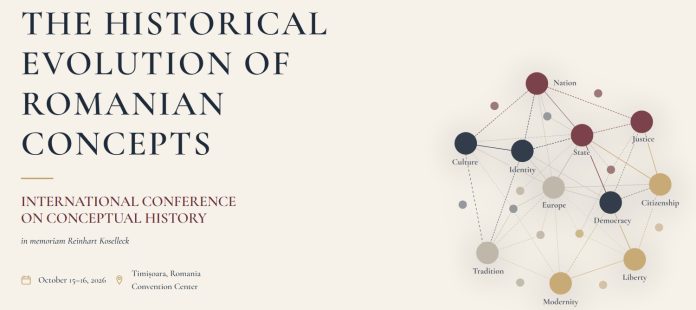
Organised under the scientific direction of historian Prof. Dr. Victor Neumann, HERC 2026 places Romania’s intellectual history within a major European framework.
Timișoara is set to become, in October 2026, the meeting point of one of the most ambitious academic initiatives dedicated to Romanian intellectual history in the Eastern European space. On 15 and 16 October 2026, the city will host “The Historical Evolution of Romanian Concepts” — HERC 2026, an international conference on conceptual history, organised at the Timișoara Convention Center and dedicated in memoriam to Reinhart Koselleck, one of the great European theorists of conceptual history. Details can be found here: HERC 2026 — The Historical Evolution of Romanian Concepts.
The event is more than a scholarly conference. It is an invitation to understand Romania through the evolution of the words, ideas and semantic structures that shaped its modern identity. HERC 2026 proposes an interdisciplinary investigation into Romanian political, social and cultural concepts, examining how their meanings changed across historical periods and how they were integrated, adapted or contested within the broader European intellectual context.
At the centre of this initiative stands Prof. Dr. Victor Neumann, the scientific director of the conference, a historian specialising in the history of Romania and Central and South-Eastern Europe. A member of the Academy of Europe, former professor at the West University of Timișoara and professor at the Bucharest National University of Arts, Neumann has long promoted a multicultural and cosmopolitan understanding of Europe’s past and present.
Romania, Read Through Its Fundamental Concepts
The intellectual strength of HERC 2026 lies in a simple but profound premise: societies are not shaped only by events, institutions and political decisions, but also by the concepts through which they understand themselves. Words such as nation, state, liberty, citizenship, democracy, culture, civilisation, Europe, identity, modernity, reform and sovereignty are not neutral labels. They carry histories, conflicts, ambitions, ideological transformations and cultural memories.
This is why the conference’s subject is both academic and deeply relevant to public life. To study the history of Romanian concepts means to investigate how modern Romanian political and cultural language was formed, how it absorbed European ideas, how it translated them into local contexts, and how it was later transformed by nationalism, totalitarianism, communism, national-communism and the democratic reconstruction after 1989.
The framework of the conference is inspired by Begriffsgeschichte, the German tradition of conceptual history developed by Reinhart Koselleck, Otto Brunner and Werner Conze through the monumental project Geschichtliche Grundbegriffe. This method analyses the semantic evolution of social and political concepts over time and is presented by HERC as particularly relevant for the Eastern European intellectual space.
A Necessary Eastern European Premiere
In a region where historical debates have often been dominated by national narratives, political ruptures and contested memories, HERC 2026 opens a more refined and demanding path. It shifts the focus from the chronology of events to the deeper vocabulary of history. It asks not only what happened, but how Romanian society named, understood, justified and reinterpreted what happened.
That makes the Timișoara conference a rare and pioneering initiative in Eastern Europe. It offers Romania the opportunity to be studied through a modern European methodology, while also placing Romanian conceptual history in dialogue with major debates in intellectual history, political thought, linguistics, literary studies, philosophy and cultural history.
The conference’s thematic architecture reflects this ambition. HERC 2026 focuses on the relationship between language and modernity, on Romania as a space of historical and institutional asynchronicities, and on the changing meanings of Europe in Romanian political and cultural thought.
Victor Neumann’s Long Intellectual Project
For Victor Neumann, HERC 2026 continues a line of research developed over decades. His work has consistently challenged simplified national narratives and has examined Central and South-Eastern Europe through the movement of ideas, identities, political languages and cultural transfers.
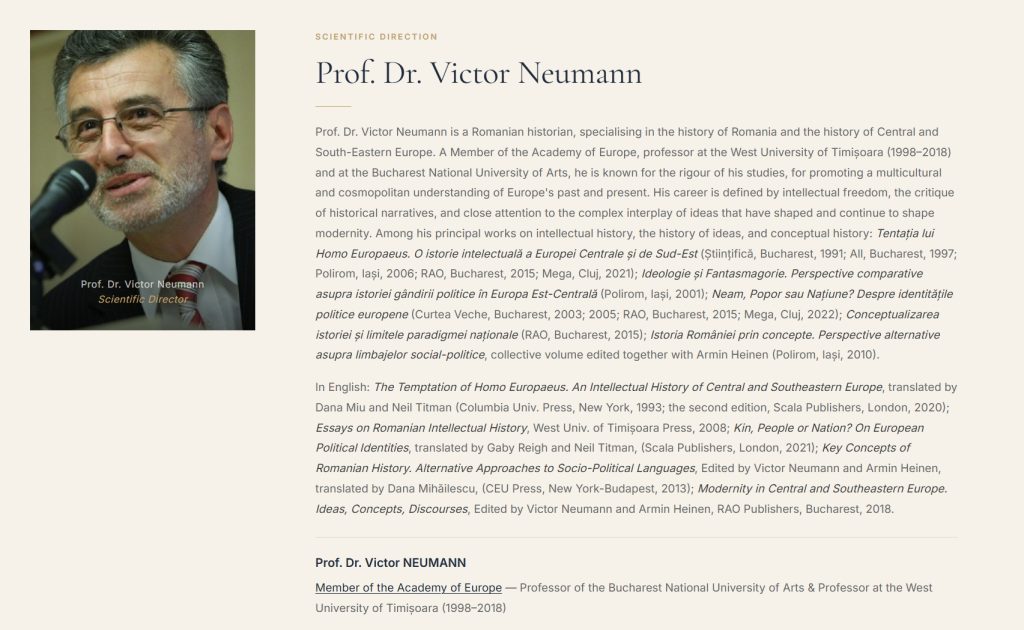
Among his major works are The Temptation of Homo Europaeus, Kin, People or Nation? On European Political Identities, Key Concepts of Romanian History. Alternative Approaches to Socio-Political Languages, and several volumes dedicated to Romanian intellectual history, conceptual history and the limits of national paradigms.
Through HERC 2026, this long scholarly effort gains a public and institutional form. Timișoara becomes not only the host city of a conference, but the symbolic centre of a research project that seeks to give Romanian culture a more precise conceptual map.
A Conference Open to International Scholars
HERC 2026 welcomes contributions from historians, linguists, philosophers, literary scholars and social scientists working on the conceptual history of Romanian and Eastern European modernity. Abstracts of 300 to 500 words must be submitted in Romanian and English and will undergo double-blind peer review. The submission deadline is 1 August 2026, with acceptance notifications scheduled for 1 September 2026 and the final programme to be published on 30 September 2026.
The academic scope is broad but coherent. Researchers are invited to address conceptual intersections, translingual transfers and comparative European contexts, especially in relation to the historical evolution of Romanian political, cultural and intellectual language.
The Lexicon of Fundamental Romanian Concepts
One of the most important outcomes of the HERC initiative is the planned Lexicon of Fundamental Romanian Concepts, a collective reference work dedicated to the historical evolution of the concepts that shaped Romanian culture, society and political thought. Each entry will analyse the history of a fundamental concept, trace its changing meanings across different historical contexts and place it in dialogue with European intellectual traditions.
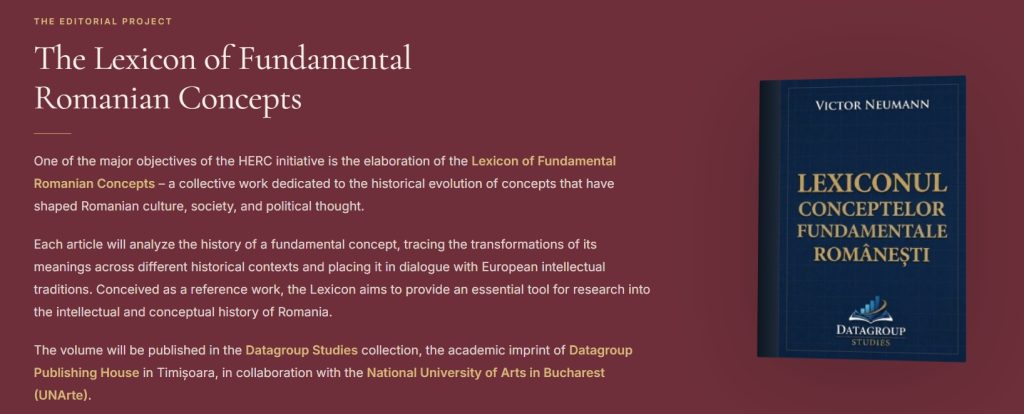
The volume is expected to appear in the Datagroup Studies collection, the academic imprint of Datagroup Publishing House in Timișoara, in collaboration with the National University of Arts in Bucharest.
This editorial project gives HERC 2026 lasting significance. The conference is not conceived as a one-time academic event, but as the beginning of a broader intellectual construction: a scholarly instrument capable of helping researchers, students and the wider educated public understand how Romania’s modern vocabulary was formed.
Timișoara, a Natural Host for a European Intellectual Dialogue
There is a strong symbolic logic in placing this conference in Timișoara. The city has long been a space of cultural crossings, linguistic plurality and Central European openness. It is a place where Romanian, German, Hungarian, Serbian, Jewish and other cultural traditions have interacted over centuries, creating a civic and intellectual atmosphere naturally suited to a conference about concepts, identities and Europe.
HERC 2026 therefore reinforces one of Timișoara’s most valuable cultural roles: that of a city where Eastern and Central European histories can be discussed without provincialism, and where Romanian culture can be understood as part of a wider European conversation.
In a public age marked by semantic confusion, ideological noise and the rapid degradation of political language, a conference dedicated to the history of concepts is more than an academic event. It is an act of intellectual clarification. It reminds us that words have histories, that concepts shape institutions, and that no society can understand its present without examining the language through which it inherited its past.
HERC 2026 places Timișoara on the map of major European debates in conceptual history. More importantly, it offers Romania a rare chance to look at itself through the deep grammar of its own modernity.


